AI in Northwestern Ontario | What Businesses Are Missing
AI Northwestern Ontario, Thunder Bay AI, Local Business Strategy
AI Is Already Changing Northwestern Ontario: What Local Businesses Need to Know
Artificial intelligence is no longer a distant concept reserved for tech hubs in Toronto or Silicon Valley. From Thunder Bay to smaller communities across Northwestern Ontario, AI is quietly reshaping how local businesses operate, serve customers, and compete. The question is no longer if AI will matter for your organization, but how quickly you can put it to work in a way that makes financial sense.
AI Northwestern Ontario: From Concept to Competitive Advantage
When people talk about AI Northwestern Ontario, they often imagine large enterprises or distant research labs. In reality, AI is already embedded in tools local businesses use every day - email marketing platforms that suggest subject lines, accounting software that flags anomalies, and social media tools that auto-generate content. These are not futuristic pilots; they are practical, revenue-focused applications available to every retailer, restaurant, clinic, and professional service firm in the region.
Nationally, AI adoption among Canadian businesses is still catching up, with fewer than one in five firms using or planning to use AI in the near term. Yet sectors such as professional services, finance, and health care are already seeing double-digit growth in adoption. Northwestern Ontario is following this trajectory, with local organizations beginning to integrate AI into marketing, scheduling, inventory, and customer service—often through software they already subscribe to, rather than custom-built systems.
Thunder Bay AI: A Growing Hub of Practical Innovation
The phrase Thunder Bay AI is starting to carry real weight. The Northwestern Ontario Innovation Centre (NOIC) has launched programs like “Building Blueprints for AI Adoption,” giving entrepreneurs structured, hands-on guidance plus access to implementation funding. For a modest fee, local businesses can receive thousands of dollars’ worth of training and qualify for up to $20,000 in support to put AI projects into practice. This is not theory—it is a direct path to operational change for small and medium-sized businesses in the region.
At the same time, Thunder Bay–based startups are demonstrating what is possible when AI is tailored to local needs. Predictive analytics firms help retailers and service providers forecast demand and optimize staffing. Agri-tech innovators apply AI to soil and crop data, supporting more sustainable practices across Northwestern Ontario’s agricultural communities. Clean-transportation ventures use AI to support electric vehicle retrofits and route optimization, aligning with broader sustainability goals. Together, these examples show that AI is not merely imported into the region; it is being built and refined here.

Local owners are using AI insights to make faster, data-backed decisions every week.
Automated Customer Responses: Meeting Expectations Around the Clock
One of the most accessible entry points into AI for local businesses is Automated Customer Responses. Customers now expect quick, accurate answers regardless of your operating hours. Whether they are booking a massage in Thunder Bay, asking about inventory at a retailer in Dryden, or inquiring about a menu in Kenora, they do not distinguish between a multinational brand and a local business when it comes to response time.
AI-powered chatbots and messaging assistants can handle common questions—hours, pricing, directions, basic product information—24/7 across your website, Facebook page, and even SMS or WhatsApp. These systems can also pre-qualify leads, route complex issues to staff, and capture contact details for follow-up. For many Northwestern Ontario businesses, the result is fewer missed opportunities and a more consistent customer experience, without adding headcount or extending shifts.
💡 Practical Tip: Start by listing your 20 most common customer questions. Configure your AI assistant to answer those reliably before expanding into more advanced workflows.
AI Business Systems: Quiet Automation Behind the Scenes
While customer-facing tools get most of the attention, the real power of AI Business Systems often lies behind the scenes. Modern point-of-sale, CRM, and booking platforms now include AI features that help local businesses automate repetitive tasks and reduce administrative overhead. In many cases, these features can be activated with configuration rather than custom development.
Smart scheduling: AI can analyze historical booking patterns, weather, and local events to recommend staffing levels, helping restaurants, clinics, and tourism operators avoid both overstaffing and understaffing.
Inventory optimization: Retailers and wholesalers can use AI-driven forecasts to time orders and manage stock, reducing both stockouts and excess inventory, which is especially important when supply chains are long and seasonal demand is unpredictable.
Financial monitoring: AI-enabled accounting tools can flag unusual transactions, highlight late-paying accounts, and project cash flow scenarios, giving owners an early warning system for financial risk.
These AI Business Systems help local leaders reclaim time for higher-value activities: building partnerships, mentoring staff, and developing new services that reflect the unique strengths of Northwestern Ontario’s communities. Importantly, national data shows that most businesses adopting AI are not cutting jobs; instead, they are reallocating people to more strategic and customer-focused work.
Business Visibility: Standing Out in a Crowded Digital Landscape
For many organizations, the most immediate payoff from AI comes through improved Business Visibility. Search engines, social platforms, and review sites increasingly rely on AI to decide which businesses to show first, which posts to amplify, and which ads to prioritize. To stay visible, local companies must align with these AI-driven systems rather than work against them.
AI-enabled marketing tools can help Northwestern Ontario businesses generate search-friendly content, manage online reviews, and run targeted ad campaigns without requiring in-house marketing teams. For example, AI can:
Suggest blog topics that local customers are actively searching for, such as seasonal activities, regional events, or industry-specific questions.
Draft responses to reviews that reflect your brand voice, while you retain final approval to ensure accuracy and professionalism.
Identify which channels—Google, Facebook, Instagram, email—are driving the most qualified leads, allowing you to reallocate budget toward what works.
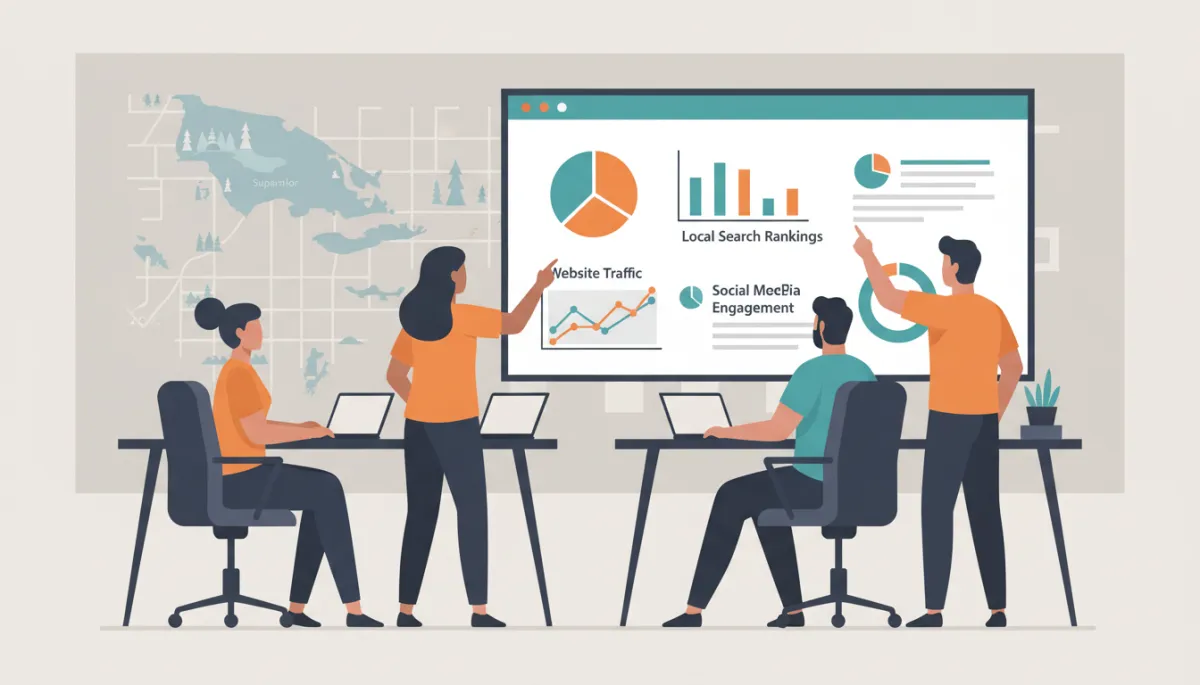
AI-powered visibility tools help local brands appear where customers are already searching.
Customer Expectations AI: The New Standard of Service
As AI becomes embedded in national and global brands, Customer Expectations AI are shifting for everyone—including local businesses in Northwestern Ontario. Customers now expect:
Faster, more accurate responses across channels, at any time of day.
Personalized offers that reflect their history and preferences, not generic mass emails.
Seamless experiences that connect in-store, online, and mobile touchpoints.
AI allows even small organizations to deliver this level of service. Email platforms can tailor subject lines and offers to individual interests. Loyalty systems can trigger rewards or reminders at the right moment. Booking tools can suggest ideal times based on past behavior. By aligning with evolving Customer Expectations AI, local businesses can compete on experience, not just price or location.
Getting Started: A Practical Roadmap for Northwestern Ontario Businesses
For many leaders, the biggest barrier is not interest but uncertainty: where to start, how much to invest, and how to manage risk. A focused, step-by-step approach can make AI adoption manageable and measurable.
If you're looking for a simple starting point, you can explore a guided setup here:
Clarify your business objective. Are you trying to reduce administrative time, increase revenue per customer, improve Business Visibility, or extend support hours? A clear goal will guide your choice of AI tools.
Audit the tools you already use. Many platforms used across Northwestern Ontario—POS systems, CRMs, accounting packages—already include AI capabilities. Turning on and configuring these features is often the fastest, lowest-risk starting point.
Start with one pilot. Choose a contained project, such as Automated Customer Responses on your website or AI-assisted review management. Define what success looks like in terms of time saved, leads generated, or customer satisfaction.
Engage local expertise. Explore programs from NOIC, regional chambers, and Thunder Bay AI startups that offer training and advisory support. Local partners understand the realities of operating in Northwestern Ontario—from seasonality and staffing to connectivity and logistics.
Build simple governance. Even small businesses should establish basic guidelines: what data is used, who approves AI-generated content, and how to handle customer concerns. This builds trust and keeps your AI initiatives aligned with your values.

Structured roadmaps help local teams move from AI ideas to measurable outcomes.
As your system matures, you can expand into lead generation, automation, and reporting:
👉 https://thunderbayai.com/scale
The Risk of Waiting
For many businesses, the biggest risk is not adopting the wrong tools—it’s waiting too long.
The gap is not dramatic at first. It shows up as:
Slower response times
Missed follow-ups
Lower visibility in search and maps
Disconnected customer data
Over time, those small gaps compound.
Businesses that respond instantly, follow up consistently, and stay visible will steadily pull ahead—especially in smaller markets like Thunder Bay.
Looking Ahead: AI as an Everyday Part of Doing Business
AI is already changing how businesses operate across Northwestern Ontario.
The opportunity is not to overhaul everything overnight—but to start building systems that:
capture opportunities
respond faster
and create consistency across your business
For teams willing to test, adapt, and evolve, AI becomes less about technology—and more about building a business that runs more efficiently every day.
If you’re exploring how to begin, start small, stay practical, and focus on outcomes.


